|
|
Sunday |
Monday |
Tuesday |
Wednesday |
Thursday |
Friday |
Saturday |
|
|
1
|
2
ShashthI
|
3
AshtamI |
4
Navami
|
5
|
6
Ekadasi
|
|
7 |
8
Onam
|
9 |
10
/images/Logos/Purnami.gif) Purnima Purnima
|
11
Mahalaya Paksham begins
|
12 |
13
|
|
14
|
15 |
16
Shashthi
|
17 |
18
Ashtami |
19
Navami
|
20
Sr Ragavendra
Aarandhana |
|
21
|
22
Ekadasi |
23
|
24
Shivratri
|
25
/images/Logos/Omlogo2.gif) Mahalaya Mahalaya
/images/Logos/Ammavasya1.gif) Amavasya Amavasya
|
26
Navarathri
|
27
|
|
28
Annamacharya Day
|
29
Chathurthi
|
30
|
|
|
|
|
|
/images/Gods_Photos/Venkateshwara.gif)
Austin Hindu Temple and Community Center is organizing Sankeertanacharya
Annamacharya Day. The day long celebrations will be filled with Annamacharya
Sankirtana Recital. The program will commence with a group rendition of the
Sapthagiri Keerthanas followed by individual/group presentations.
The program committee invites you all to participate in the
celebrations. If you are interested in either solo or group singing, please
register your song and raga on or before August 27th, 2003. For details and
registration contact one of the volunteers below.
Please mark your calendars and plan to attend.
| Date : |
September 28th, 2003. |
| Time : |
12:30PM - 5:00PM |
| Venue: |
UT Arts Auditorium, 2300 San Jacinto, Austin, TX - 78712 |
Click here for driving directions from your destination
Yahoo! Maps
Click here for
Event guidelines and pre-registration
/images/Gods_Photos/Annamacharya%20photo.gif)
Sri Tallapaka Annamacharya (1408-1503) the mystic saint composer of the 15th
century is the earliest known musician of South India to compose songs called
sankIrtanas in praise of Lord Venkateswara, the deity of Seven Hills in Tirumala,
India. Annamcharya is believed to be the incarnation of Lord Venkateswara's.
nandaka (Sword). A rhyming couplet of poems called dwipada written by Tallapaka
Chinnanna, grandson of Annamacharya, enabled us to learn about Annamacharya's
life and works.
It is believed that in the 10th century a big famine broke out in Varanasi
and scores of scholars migrated to southern part of India for earning their
livelihoods. Some of them concentrated in a town called Nandavaram in Andhra
Pradesh which was ruled by the then king Nanda. These immigrants were called
Nandavarikas and Annamacharyas forefathers were the so called Nandavarikas and
hence Annamacharya.
In the Dwipada the story of Annamacharya goes back three generations to his
grandfather Narayanayya. As a boy Narayanayya was not keen in studies and it was
customary in those times for the gurus to subject the students to different
kinds of torturous methods to create concentration on studies. When nothing
worked for the young boy, he decided that death would be better than the life
filled with torture, humiliation, and shame. He heard about the venomous cobra
in the snake hole at the temple of Chinthalamma the village Goddess. In an
attempt to take his life away, Narayanayya put his hand in the snake hole at the
temple. To his surprise, the village Goddess appeared before him and advised him
not to take his life away since a boy with an element of Hari or Vishnu would be
born in the third generation of Narayanayya.
Narayana Suri, the son of Narayanayya, did not have children for a long time.
Narayana Suri and his wife Lakkamamba visited Tirumala Temple and while they
were prostrating in front of the Holy Mast (Dhwaja Sthambha) a dazzling
brilliance from the sword of Lord Venkateswara struck them like a lightening.
Eventually a boy was born to them and they named him Annamayya. Annamayya became
Annamacharya when the sage Ghana Vishnu at Tirumala converted him into a
Vaishnavaite at the age of 8.
During his long and prolific career, Annamacharya composed and sang 32,000
Sankirtanas, 12 Satakas (sets of hundred verses), Ramayana in the form of
dwipada, sankIrtana lakshaNam (Characteristics of sankIrtanas), SRngAra manjari,
and vEnkaTAchala mahAtmamyam. His works were in Telugu, Sanskrit and a few other
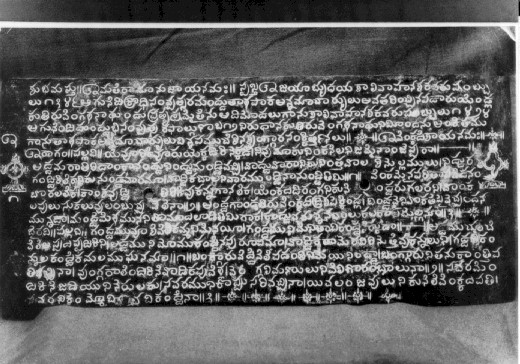
languages of India. Annamacharya wrote the sankIrtanas on palm leaves and later
his son Tirumalacharya got them engraved on copper plates. But for reasons not
known, most of these copper plates lay hidden in the Tirumala temple unnoticed
for over 400 years. In 1922, twenty five hundred copper plates, comprising of
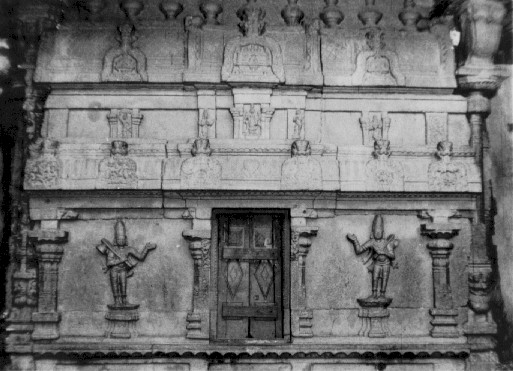
about 14,000 sankIrtanas and a few other works, were found in a rock built cell,
later named as Sankirtana Bhandagaram, opposite to the hunDI (donation box) .
Admission: Free
If you are interested in registering please contact the event coordinators at
culturalinfo@austinhindutemple.org
or call
| Mythily Srinivasan |
335-3409 |
| Krishnamohan Gobburu |
341-9753 |
| Balaji Janakiraman |
241-0434 |
| Radharani Tupuri |
301-7418 |
The photographs and other details are obtained from Sri Venkateswara
Annamacharya Society of America (SVASA).
sarvE janAh suKhinO Bavantu

Last Updated: 03/17/03